Showing posts with label riding gear. Show all posts

Friday, July 9, 2010

Stopping the “Booming” Helmet Noise when Highway Riding

I hate riding the highways in the city, but once I’m away from all those horrible drivers, I love it. One thing I did notice during my first highway ride of the season was a loud booming noise every time I went faster than 80 kph. The faster I went, the louder I got. I didn’t have the problem last year with my previous helmet, so I knew it was the helmet and not my over-sensitive ears.

After doing a bit of searching on the Internet, I discovered the booming is made from air being force up into the helmet from around the neck. The solution is to purchase a sleeve or skirt that permanently attaches to the helmet. However, none offered for sale are made for modular, or flip-up, helmets.

As I understand the science behind attaching a skirt, it prevents the wind from going into the gap(s) around the chin and neck and vibrating the helmet. The air is forced in, with very few areas to escape, so it rattles around in the helmet and basically turns the helmet into a bass drum.

I knew that I didn’t want nor need a perfectly air tight seal around my neck. I put on my helmet and found that I could touch the back of my ear with my fingers. The gap around my jaw line was just as bad, and there was also a large gap at the back of my neck. For a helmet that fit my head so well, it fit also fit very poorly.

I rummaged through some scrap material and found about a metre of polar fleece, which was the remnants of a winter scarf. While polar fleece is not windproof, I hoped it would disrupt the wind flow enough to stop the boom while still let in air to breath and cool my face.

I stitched the fleece onto the helmet’s check pads and along the rather useless wind proofing material on the sides. Once completed, it looked as if there was barely room for my head to hit in to the helmet. But as the fleece was not pulled tight when I stitched it to the helmet, there was enough give in the material for me to move the fleece aside and pull on the helmet.

As an added touch, I put two strips of electrical tape at the rear of the helmet where it meets the fleece. I was a bit suspicious of water running down onto the fleece and thought the tape would help keep the water dripping downwards and not wick into my helmet through the fleece.
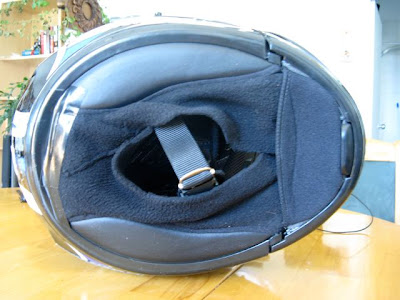
I obviously couldn’t attach the fleece all the way around to include my chin, as I wanted to keep my helmet flip-able, if you know what I mean. The fleece tucks neatly under, up and along my cheek pads, thus it is up against the fabric installed on the helmet under my chin. To make sure there wasn’t a gap, I used a few small pieces of weather stripping around the edges.

I’ve been riding with my polar fleece helmet skirt for over a n month and the only time I get the booming sound on the highway is when I forget to pull the fleece down my neck. You see, when I put my helmet on, my head pushes the fleece into the helmet. This doesn’t give it enough wind protection as when it is outside the helmet and against my neck.

I was out last weekend in 38° C weather (in other words, really hot) and riding on the highway. My neck wasn’t any hotter than the rest of me. The fleece doesn’t act as insulation, but as a bit of a windbreak while still being breathable. Rain has caused a bit of a problem, but it is only noticeable when I remove my helmet. The fleece gets damp and it is a bit uncomfortable putting the helmet back on with damp fleece. Water doesn’t run down my neck because of the skirt; however, it my have something to do with my waterproof jacket, but I can’t be sure.

It took me about an hour to cut and stitch the skirt on, which I consider time well infested to get rid of the bass drum sitting on my head

Wednesday, July 7, 2010

Wearing Ear Plugs for Maximum Protection While Riding

I’ve been extremely protective of my hearing for years. I go to concerts and clubs with ear plugs, and I’ve operated machinery with Peltor earmuffs. I even find my vacuum cleaner so loud that I operate it wearing my Peltors.

Before I started riding, I knew that I would need the best ear protection possible, but I quickly found out that ear protection starts with the helmet and not with my ears, but for this posting I will only talk about my experience with ear plugs

Like many riders, I started with the bright orange pylon shaped foam ear plugs. These are usually rated at 33 or 34 db, which is the highest I’ve been able to find. I’ve been told that I have very small ear canals, which may explain why I’ve never found a good fitting ear plug.

Last riding season I discovered a brilliant way to get a better fit. I pour water over the ear plugs just prior to inserting them in my ear. I had two reasons for trying this. First, the water lubricates the ear canal to make insertion easier. Secondly, some water is absorbed into the foam, which makes it denser, and (imho) doesn’t allow as much sound to get through. I know that sound travels extreme distances underwater, so perhaps this is counterintuitive. I have found that the ear plugs now go all the way and don’t work their way loose.

I’ve noticed that water soaked ear plugs create a bit of suction when removing them from the ear canal. To avoid the “pop,” and possible damage to the ear drum, I twist them as I pull them out. This allows some air to slowly enter the ear and it equalizes the pressure.

If you decided to try watering your ear plugs, I suggest that you let them air dry overnight before using them again, as they seem to last longer. Also, I carry a small bottle of water with me, and I’ve found that I have to pour water over the plugs even if I’ve taken them out for only a couple of minutes, otherwise, they won’t slide in as intended.

Last winter, at one of the motorcycle shows, I purchase custom silicone ear plugs. I rode with them through April and May this year, and have since returned to the orange pylon ear plugs. I had two problems with the custom set. First, they seemed to pick up a lot of bass sounds, such as rumbling from the bike’s engine. I’m not sure if this is because of the solid construction of the ear plugs or because they may be contacting the bones around my ear and carrying the rumble to my ear drum. A few years ago I read about a new type of earphones that contacted one of the bones around the ear to carry the sound directly to the ear, so the logic is sound with my thinking, but I’m not sure if the ear plug is connecting to that specific bone.

Finally, when I was fitted for the custom ear plugs, I wasn’t wearing my helmet. With the helmet pressing tightly against the side of my face, I find it more comfortable to ride with my a bit of a slack jaw (my upper and lower teeth do not touch). This changes the shape of my ear canal and the custom plugs don’t fit me very well as sound easily get in.

I still carry my custom ear plug with me, but will use them only if I lose the pylons. If you are wondering, the custom earplug sales person told me that they would cut out about 34 db, which is the same as the pylons.

Saturday, July 3, 2010

Motorcycle Helmet Speakers

After my ride to Tobermoray, I knew I would be bored silly with parts of the ride on my upcoming Big Trip. As the Big Trip is costing me a few pennies, I knew that a state-of-the-art helmet sound system was out of the question. All I needed was a couple of speakers to fit in the rather deep ear cavities in my helmet. Not too much to ask.

A quick look on the Internet proved that I wasn’t only one who wanted tunes in my head and not coming from my none-existent fairing speakers. I’d never use those speakers even if I had them, as I don’t believe in polluting other people’s peace and quiet. I hate listening to other people’s noise, so I won’t subject them to mine.

I found a site that suggested buying an amplifier and then clipping ear buds into the helmet. While that’s an alternative to not having tunes, there had to be something better. I pondered the problem and then I remembered I have an old pair of earphone I had bought from Radio Shack for about $20 in 2001. The clip to hold it over my head is broken and they are useless. The foam padding is also slowly disintegrating, so the earphones will leave a trail of foam pieces whenever used, but I couldn’t bring myself to throw them out.

I removed the overhead clip and, fortunately, my Gmax helmet has loads of ear room. In fact it has so much room that I’d put about an inch of hard foam in them to cut down on the road noise (not too sure if that worked or not). The earphones were a bit of a tight squeeze, but they fit in to the helmet perfectly and the sound is fantastic.

If you want speakers for you motorcycle helmet, go to Radio Shack (or The Source as it’s now called in Canada) and pick up some earphones. I’d suggest you take your helmet with you to guess-timate the size. But, for say $30 (inflation), I don’t think you can go wrong. The only fancy thing I’m missing is an in-line volume control.

I’m not going to bother with another RAM mount for the iPod. I don’t feel comfortable with it out in the heat of the day and in direct sunlight for hours on end. It will fit nicely into my tank bag. When it rains, I can easily (I hope) disconnect the iPod, put the rain cover over the tank bag and then tuck the earphone wires into my riding jacket pocket.

If I’m on a ride where I don’t want to listen to music, I can also easily remove the earphones, as they are a press fit into the helmet.

I'm looking forward to tomorrow's ride when I will definitely try out the "new" speakers.

Pictured below are the earphones assembled and then with the head clip removed. I couldn’t get a half decent shot of the earphones in the helmet.


Wednesday, June 23, 2010

Rain Off Overgloves Kept my Hands Dry

It finally rained while I was riding. I’ve been looking forward to this for about two weeks, which is how long I’ve had my Rain Off Overgloves in my saddlebag waiting for the right moment.

I have Gor-Tex riding gloves, but as I mentioned in a previous post, they are insulated and just not suitable for summer riding. I will of course take these gloves with me on the Big Trip, but more for their warmth and not water resistance abilities. Last time I went through Roger Pass there was snow at the side of the road – and that was at the end of August. While I hope not to see the fluffy white stuff, I do expect low temperature in some of the high passes and mountain ranges.

Last time I wore the Gor-Tex gloves, it was about 25C and I was just so overheated that I had devised a plan to buy a Gor-Tex jacket and then cut and stitch them into something that would go over my regular summer riding gloves. But instead of taking that drastic step, I hit the Internet and stumbled across the Rain Off Overgloves.

They come in two different styles. While both have an independent thumb, one version has the index finger on its own with the other three fingers in a mitt, for lack of better term. I purchased the two-and-two version, which has two fingers in each mitt and an independent thumb.

For the 60-something dollar price tag, I thought it was worth a try. I reasoned it is cheaper than my original thought.

I had to order these online from Farklemaster in Long Island, as the overgloves are not available at motorcycle stores in Canada. I half expected to pay duty on the gloves, but they arrived in just over a week without duty and without getting stuck at customs.

On my way home from work yesterday, the skies started to look ominous. I pulled over just as the rain started. The overgloves fit nicely over my summer gloves, but the problem was how to tighten the drawstring at the top of each glove. I managed to get the right hand one done up just as the rain came down in sheets. To make sure I had a good rain-proof fit, I hooked the end of the drawstring around my handlebar and pulled the toggled tight.

This was impossible for me to do in the pouring rain on my left-hand glove. I couldn’t slide the toggle down far enough to create a loop to go over the handlebar. Eventually I gave up and decided to ride anyway.

The ride home took just over half an hour and I’m happy to say both hands – and riding gloves - stayed dry despite the toggle problem on the left overglove.

My hands did not overheat and I was quite comfortable. I hardly noticed that I had them on. I expect that some riders who do not use all their fingers for clutching and braking would find the overgloves a bit restrictive, especially those who one-finger the brake. Just like any new piece of equipment, it takes a bit of getting used. But the Rain Off Overgloves are just perfect for me.

Before ordering the overgloves, I did a bit of research and found the review on Web Bike World very helpful. They also seemed to have the same problem I did, so I half expected these issues.

I was a bit hesitant when I saw how large the size small is. Admittedly, they could be a bit tighter fit, but it’s not bothersome in the least. If you are looking for dry hands this summer, I highly recommend the Rain Off Overgloves.